Bears on the Michinoku Coastal Trail:
Safety, Sightings & What to Carry
Last updated: September 2026
Yes, there are bears on the Michinoku Coastal Trail. Asiatic black bears live in the forests of Tohoku, and hikers should treat forested and mountainous sections of the route as bear habitat.
But it is important to put the risk in perspective.
I know many, many people who have walked the MCT, including hikers who have covered hundreds or more than 1,000 kilometres, and the vast majority have never had any problem with bears. Many have never seen one at all.
So this isn't a reason to be afraid of walking the MCT. It is simply something to be prepared for, much as you would be on other hiking trails through bear habitat.
A few sensible precautions go a long way: make your presence known, stay alert in forested areas, check recent sightings and know what to do if you encounter a bear.
Important: I'm an experienced MCT hiker, not a wildlife expert. This guide combines my own experience with current guidance from the Michinoku Coastal Trail Association and Japanese authorities. Always check current official information before hiking.
Are there bears along the Michinoku Coastal Trail?
Yes. The species found in Tohoku is the Asiatic black bear (tsukinowaguma / ツキノワグマ), sometimes called a moon bear because of the pale crescent-shaped marking often visible on its chest. The Michinoku Coastal Trail Association currently advises hikers to assume that almost all mountainous areas around the MCT route are bear habitat. That doesn't mean bears are equally likely everywhere, or that you're likely to encounter one. It simply means I wouldn't divide the trail into supposedly "safe" and "bear" sections. Bears have also been reported near roads and settlements, so basic precautions aren't only relevant when you're deep in the mountains.
Bears live along the MCT, but the vast majority of hikers have never had any problem with them. Make your presence known, stay aware, check recent sightings and know what to do if you encounter one.
My bear encounter on the MCT
I’ve been walking sections of the trail since 2017, and have only ever had one bear encounter. It was during my 2022 thruhike, just north of Jodogahama in Miyako. A bear appeared about 15 metres away, inside a boat (!) that was being stored on the shore. Its head popped out, we briefly looked at each other, and I slowly backed away without turning my back. Within seconds, it scuttled away and disappeared into the trees. I'd been playing the radio loudly from my Iphone speakers at the time to let wildlife know I was in the area, as I was solo hiking this section. While it was definitely a pretty exciting/terrifying/wondrous moment (how often can one see a wild bear?!), the encounter reinforced the value of making your presence known. Bears generally try to avoid people, so giving them plenty of warning that you're approaching can help reduce surprise encounters.
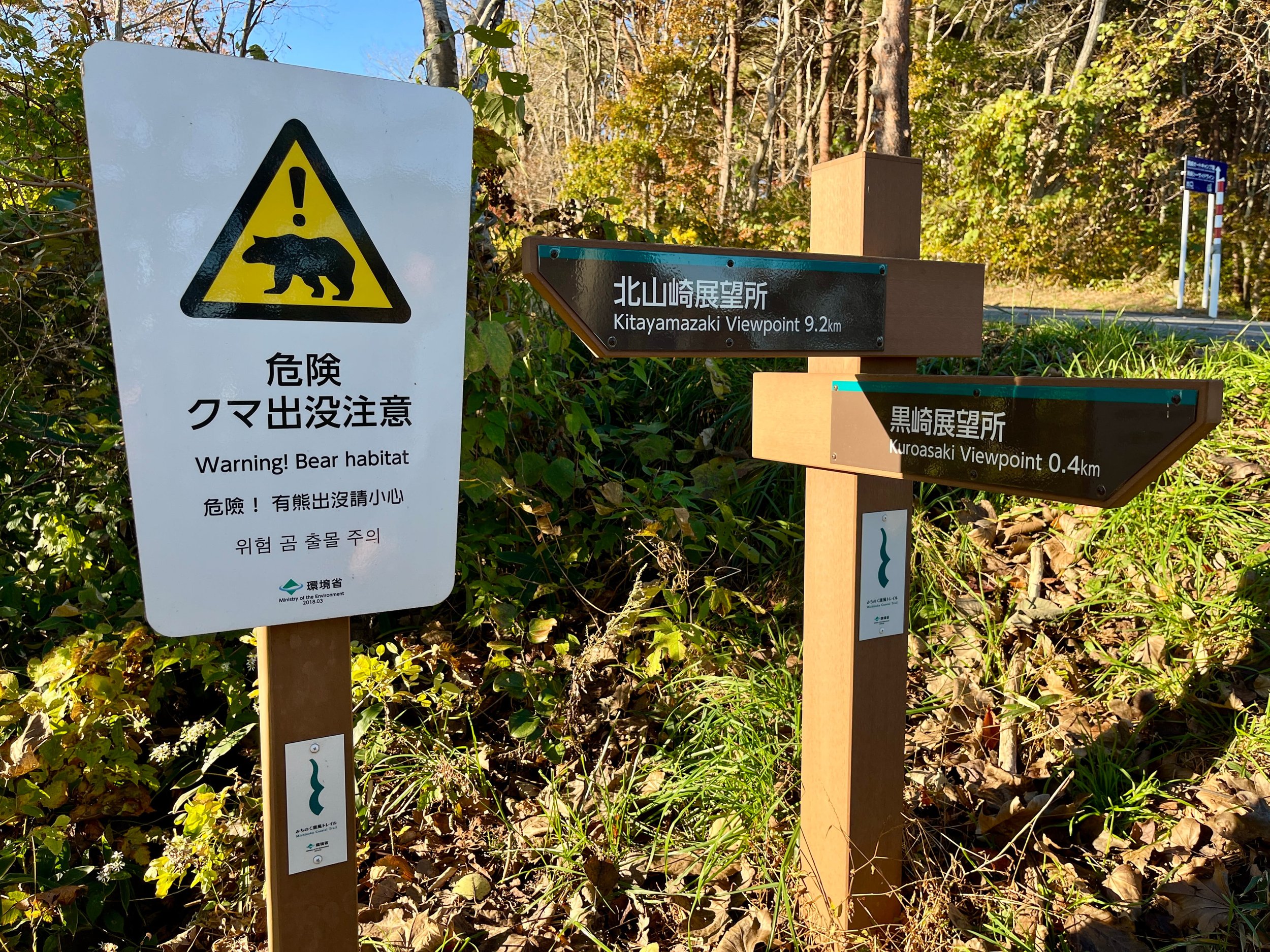
Bear warning sign near Kitayamazaki, Iwate
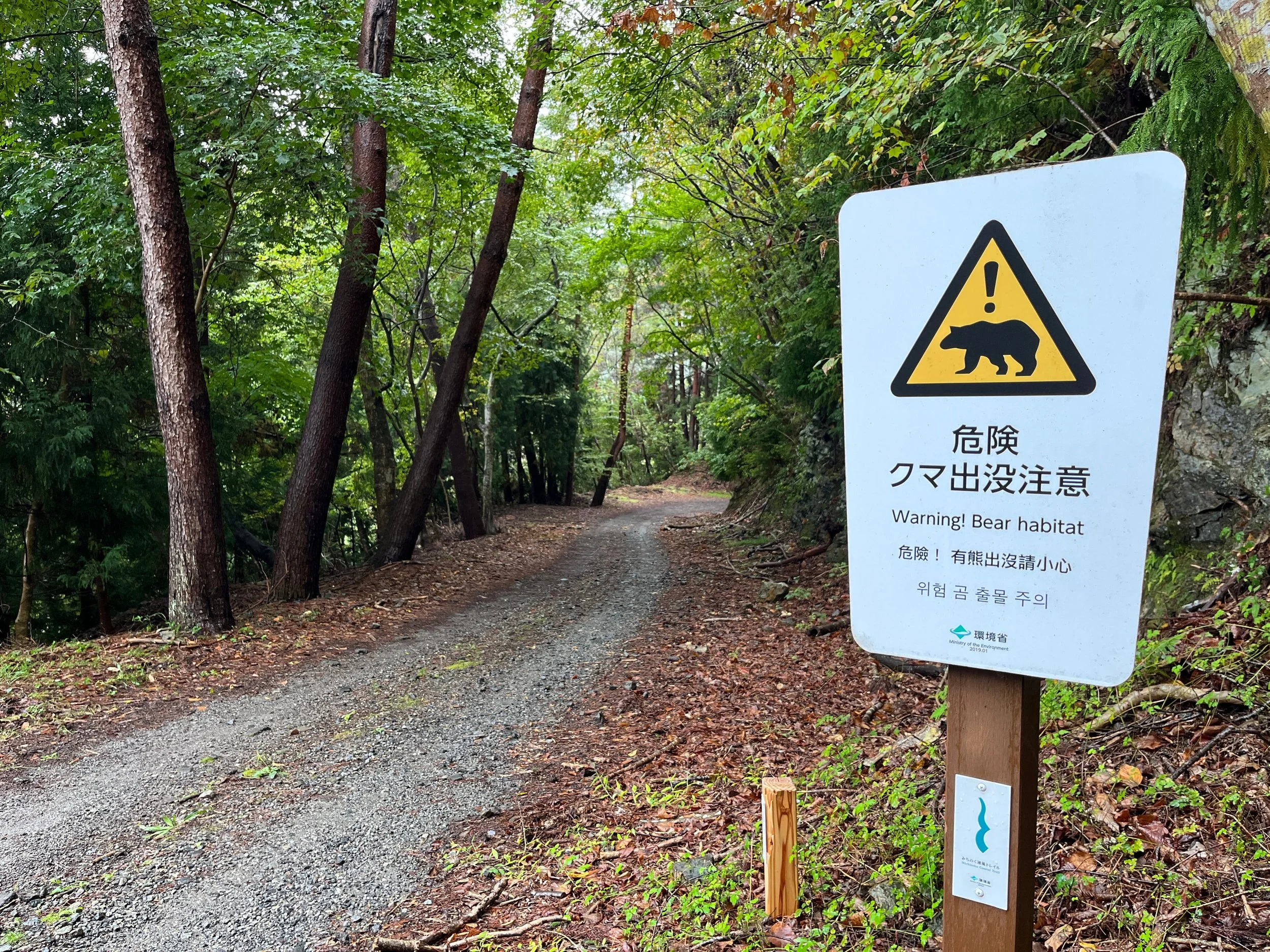
Bear warning sign along the Michinoku Coastal Trail
How to reduce your chances of encountering a bear
Avoiding a close encounter in the first place is the priority.
1. Make your presence known: This is probably the simplest thing you can do. MCTA recommends carrying something that makes noise, such as a bear bell or radio. Talking, singing, periodically using a whistle, or making noise with trekking poles can also help. This is particularly worth remembering on blind corners, in thick vegetation, beside streams where water masks other sounds, during rain or strong wind, and anywhere visibility is poor. You don't need to spend an entire hike making as much noise as possible. The point is simply to give a bear enough warning that a human is approaching.
Bear bells: Bear bells are extremely common among hikers in Japan. They're light, inexpensive and easy to attach to your backpack. I prefer a bell that can be silenced easily, because a constantly ringing bell gets old quickly when you arrive back in a village, get on a train or stop for lunch.
Silenceable Bear Bell
A straightforward bear bell with a quiet / silence function. I particularly like being able to switch it off when leaving the forest and entering villages, trains or accommodation.
View on Amazon Japan →Silenceable Bear Bell + Whistle
A good alternative if you also want a whistle as part of your general hiking safety kit. The bell can also be silenced when you don't need it.
View on Amazon Japan →2. Take extra care early and late in the day: MCTA recommends avoiding hiking in the early morning, evening and at night where possible. For long-distance hikers, that is worth keeping in mind when planning very early starts or pushing on after dark. It doesn't mean you can never walk early. It simply means being particularly alert and making your presence obvious.
3. Pay attention to signs of recent activity: If you see obvious signs of a bear, including fresh droppings or footprints, take them seriously. MCTA recommends considering turning back if you encounter these signs. At the very least, be particularly alert, make your presence known and check whether there have been recent sightings nearby.
4. Never approach a cub: If you see a bear cub, don't approach it, however photogenic it might look. Its mother may be close by. Calmly give it plenty of space and leave the area.
5. Be sensible with food when camping: Don't leave food, rubbish or bags containing food unattended around your tent. Keep food and rubbish sealed as well as you reasonably can, and use food lockers or other dedicated storage where a campsite provides them. Japan's official National Parks guidance recommends storing belongings in airtight containers where possible.
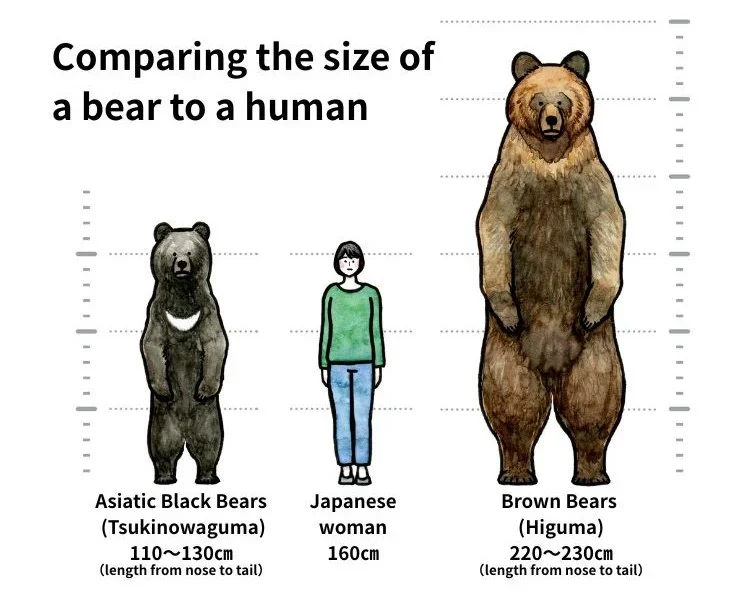
Asiatic black bears live in Honshu, including along the MCT, while brown bears live in Hokkaido. Source: JNTO
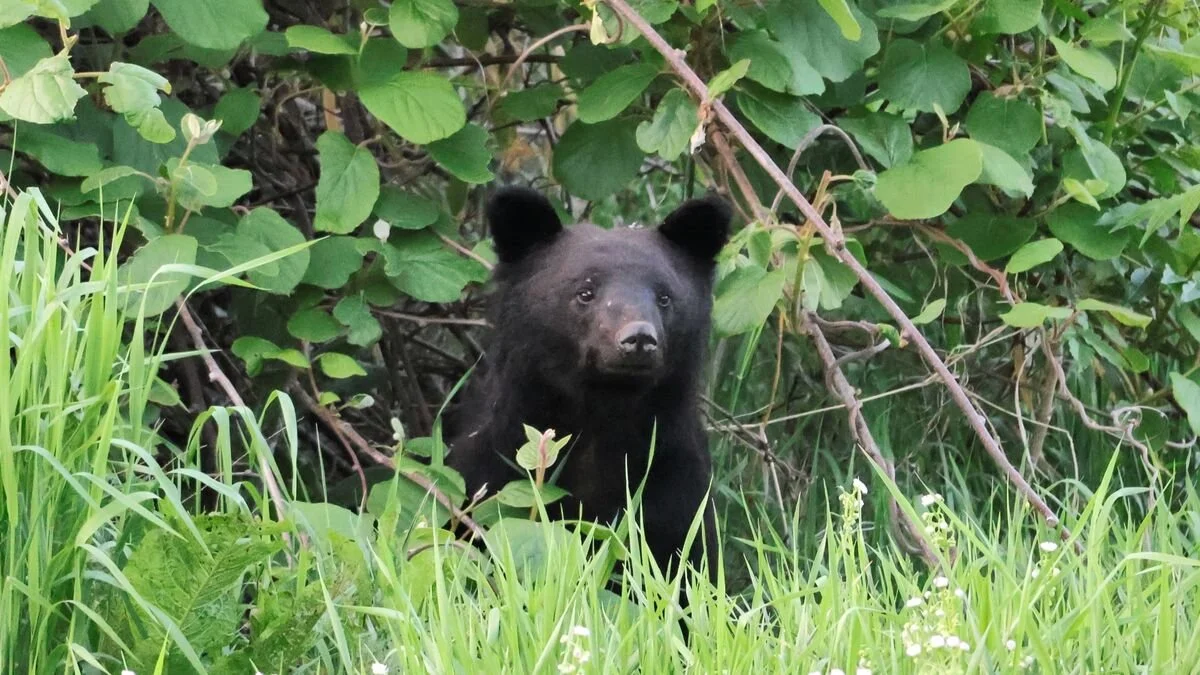
Asiatic Black Bear (tsukinowaguma). Source: Kahoku News
What should you do if you see a bear?
The main thing is not to panic and run. If you see a bear at a distance, stay calm and slowly leave the area. If the bear is closer:
don't run
don't turn and run away
don't shout at it
don't approach it for a photograph
don't throw things at it
slowly back away while keeping the bear in sight
You don't need to stare the bear down. The important thing is to remain calm and not turn around and run. If you are attacked, current Japanese Ministry of the Environment guidance recommends lying face down and protecting your neck, face and abdomen. MCTA also advises using your arms and backpack to protect your face, neck and head where possible.
Should I carry bear spray on the MCT?
This is ultimately a personal decision. A bear bell is much more commonly carried by hikers in Japan, and the first priority should always be avoiding a close encounter. Bear spray, however, can provide an additional last-resort option during a close encounter. For someone spending a lot of time on remote and forested parts of the MCT, particularly when hiking alone, I think it is reasonable to consider carrying it. There is one particularly important point for international visitors. Generally speaking, you can't take bear spray on a passenger flight - bear spray cannot be carried onto an aircraft in either your cabin baggage or checked luggage. If you're flying to Japan, you'll therefore need to buy or rent it after you arrive; the official National Parks of Japan bear guidance explains this in more detail. Amazon can be a convenient way of buying it once you're in Japan; if you're planning to have it delivered to a hotel, guesthouse or other accommodation, check with them first that they can receive the delivery for you. The same problem applies when you fly home, so if you buy bear spray, make a plan for it before you leave Japan. Some MCT hikers arrange an in-person handover of unused spray to another hiker through the MCT Facebook Group; check current rules and make sure any handover is done safely!
Choosing bear spray in Japan
Not everything advertised online as "bear spray" necessarily performs the same way. In August 2026, Japan's Ministry of the Environment published recommended performance criteria to help consumers compare products with very different specifications.
What to look for in bear spray
Japan's Ministry of the Environment recommends approximately:
*The Ministry recommends a cone-shaped mist rather than a narrow liquid stream and says the spray should have a safety mechanism that won't easily release accidentally. It also recommends carrying the spray around your waist or chest, where you can reach it immediately. Carrying it inside your backpack or in a side pocket when you may need it is specifically not recommended.
**Japan's Consumer Affairs Agency guidance also advises choosing a product specifically designed for deterring bears, rather than assuming that any human-use pepper spray or general animal deterrent is suitable.
Bear spray options
After doing some research into the new 2026 government recommendations, I've narrowed this down to two established bear-spray options rather than listing every product available.
SABRE Frontiersman Bear Spray + Holster
The published specifications for the 272ml Frontiersman model appear to align closely with the Ministry of the Environment's new recommendations, including its concentration, long spray range, spray duration and broad mist-style spray.
It also comes with a holster, making it easier to carry somewhere immediately accessible rather than buried inside your backpack.
View Frontiersman on Amazon Japan →Check the current model, specifications, seller and expiry date before purchasing. Amazon stock and product batches can change.
UDAP Bear Spray + Holster
UDAP is another established specialist bear-spray manufacturer, founded by a survivor of a bear attack. I like its straightforward design and accessible holster setup.
Published specifications and testing for the UDAP model linked below align with most of the Ministry's recommendations, making it another option for hikers who want to carry bear spray.
View UDAP on Amazon Japan →Check the current model, specifications, seller and expiry date before purchasing.
*Bear spray is not a campsite repellent (!) Don't spray bear spray on your tent, clothes or surrounding vegetation in an attempt to keep bears away. Bear spray is intended as a close-encounter deterrent. Read the instructions, watch a video, and understand how your particular product works before you need it.
Renting bear spray
For shorter hikes, renting may be easier than buying, especially since you can't take bear spray on a plane.
Kamaishi DMC offers bear-spray rental for MCT hikers around Nebama/Kamaishi. Details →
Montbell rents bear spray from selected stores around Japan, including Tohoku. Details →
From late September 2026, the Ministry of the Environment plans an MCT-specific rental pilot at seven trail information bases, with the option to return the spray at a different base (details TBD).
For a short section hike, that can be a very practical option. For a longer thruhike, buying may still be simpler depending on where you start and finish.
Check recent bear sightings before you walk
Bear activity changes, so it's worth checking current information before entering a remote or heavily forested section.
Current bear sightings & official alerts
Bear activity changes. Check recent information before entering remote or heavily forested sections.
KUMAMAP is an independent service. Use it alongside official MCTA and government information.
MCTA also links to official bear information for each of the four prefectures crossed by the trail:
If you're heading into a remote section, checking recent information takes only a minute.
A note on recent incidents
There have occasionally been incidents involving bears and people on or close to the MCT route, including an incident involving a hiker in Noda Village in July 2026. I mention this not to make the trail sound dangerous, but because it reinforces why MCTA asks hikers to take basic precautions. These incidents are not representative of the experience of the vast majority of MCT hikers I know. Most people I know who've walked substantial distances on the trail have never had a problem with a bear, and many have never seen one. Take the risk seriously enough to prepare for it, but then - most importantly - enjoy the walk!
Should bears put me off walking the MCT?
For me, absolutely not. I've walked the MCT extensively and I've had one (very brief) bear encounter. It was close enough to get my attention, but the bear disappeared almost immediately. The aim isn't to spend your hike worrying that something is hiding behind every tree. It's simply to stack the odds in your favour:
Make your presence known.
Stay aware.
Avoid surprising a bear.
Check recent sightings.
Know what to do if you encounter one.
My MCT Bear Safety Gear
Four practical options if you just want to see what I'd consider carrying.
Affiliate links. Amazon prices, stock and delivery estimates change. For bear spray, check the current model, specifications, seller and expiry date before ordering.
Bear FAQ
Are there bears on the Michinoku Coastal Trail?
Yes. Asiatic black bears inhabit forested and mountainous areas around much of the MCT. While it is important to be aware and take all precautions, many MCT hikers I know have never seen one, and the vast majority of hikers I know have never had any problem with bears.
What kind of bears live in Tohoku?
Asiatic black bears (tsukinowaguma). Japan's much larger brown bears live in Hokkaido, not along the Michinoku Coastal Trail.
Where are bears most common on the MCT?
I wouldn't rely on a fixed "bear danger map." MCTA advises hikers to treat mountainous areas around almost the entire route as bear habitat. Sightings change over time, so check recent reports rather than relying on a fixed list of hotspots.
Do I need a bear bell on the MCT?
I'd recommend one for forest and mountain sections. It doesn't guarantee you won't encounter a bear. The purpose is to make your presence known so that a bear has an opportunity to move away before you unexpectedly meet.
Should I carry bear spray?
It isn't something every MCT hiker carries and it isn't a substitute for avoiding encounters. But I think it is reasonable to consider, particularly for solo hikers spending extended periods in remote forest. If carrying it would also make you feel more confident, that can be another good reason to have it, provided you understand how to use it.
Can I bring bear spray to Japan on a plane?
No. Bear spray cannot be carried onto or checked into an aircraft. Arrange to buy or rent it after arriving in Japan.
What should I do if I see a bear cub?
Don't approach it. Give it plenty of space and leave calmly because its mother may be nearby.
Should I run from a bear?
No. Stay calm and slowly back away while keeping the bear in sight.
Are there bears in winter?
Most Asiatic black bears normally den during winter, although activity periods vary according to local climate and conditions. Don't assume that winter means zero risk. Continue following basic precautions and check current local information.
Official bear information and useful resources
For current information, I recommend:
Continue planning your MCT trip
MichinokuTrail.com participates in the Amazon Associates Program and may earn from qualifying purchases.